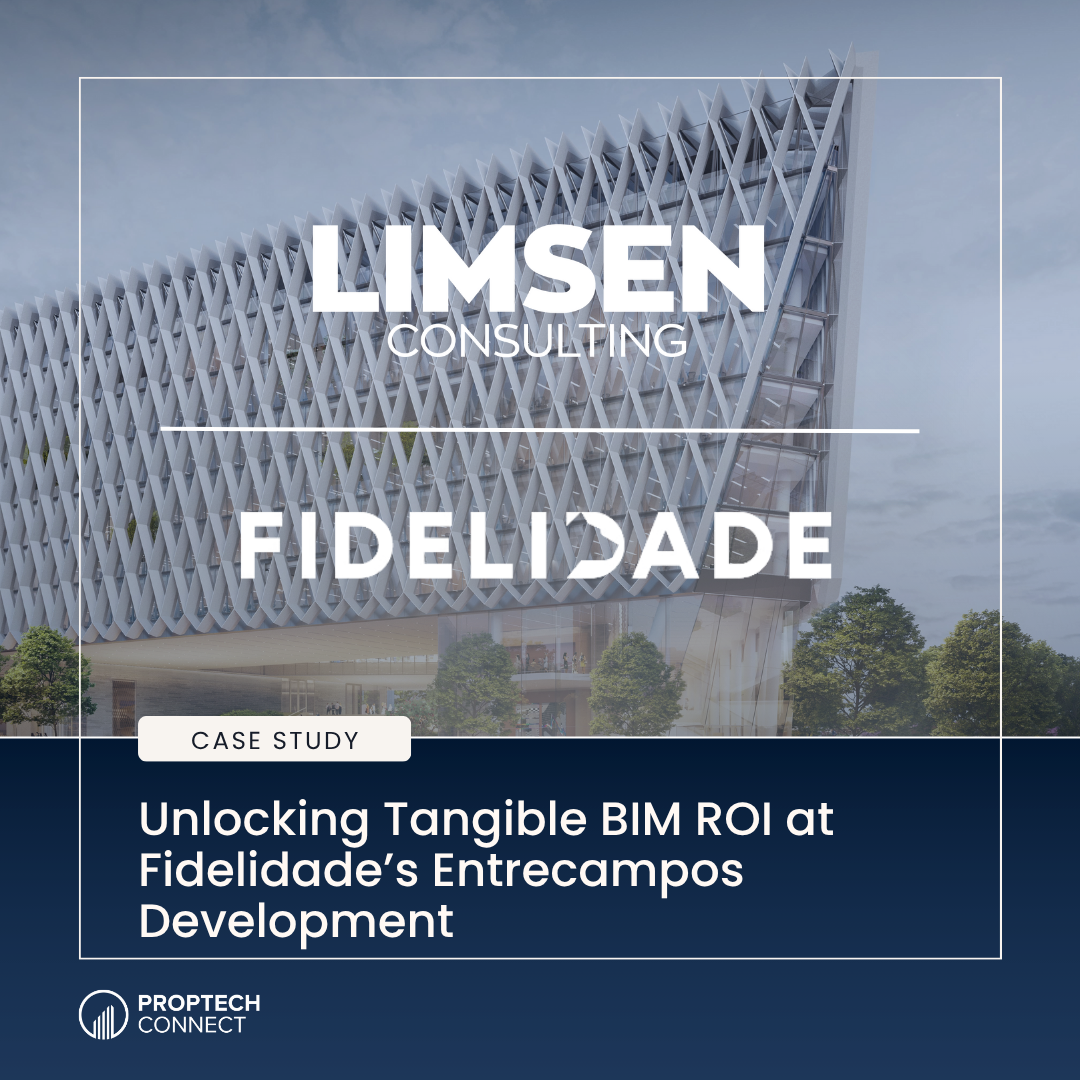
Imagine investing just 3.5% of your construction budget in Building Information Modelling (BIM) and realizing over 10% in project savings. A recent dissertation, “The Value of BIM for Owners,” highlights how a strategic BIM approach dramatically improved outcomes on a large mixed-use development in Lisbon. For property owners, this showcases how BIM is no longer just a tech upgrade, it’s a powerful tool for reducing costs, managing risks, and enhancing project transparency.
Project objectives
Private owners in the Architecture, Engineering, and Construction (AEC) sector often face persistent inefficiencies: poor collaboration, late-stage change orders, cost overruns, and lack of data visibility. Lack of transparency often hinders effective decision-making, while late-stage change orders can severely inflate costs and disrupt timelines. For Fidelidade’s Entrecampos Development, a ~300,000 sqm mixed-use development in Lisbon, the owner needed to manage complexity across multiple buildings while avoiding delays, budget inflation, and misaligned stakeholder expectations. Traditional methods lacked transparency and early issue detection, whereas a managed BIM process offers a powerful solution to these deep-rooted issues. One of the most significant advantages owners experience is a drastic reduction in change orders and rework.
Owner-led BIM transformation for risk reduction
As part of its first BIM-enabled development, the owner of Entrecampos committed to a structured and comprehensive approach managed by LIMSEN Consulting. The strategy was designed not just to digitize construction processes, but to reframe the way information was created, shared, and acted upon across the lifecycle of the project:
- Integrated BIM Management
A unified BIM strategy was established across all building plots within the development, ensuring consistency in standards, deliverables, and workflows. This framework prioritized early-stage clash detection between disciplines, significantly reducing the likelihood of costly onsite corrections. Design precision became a measurable goal, with scheduled model audits and alignment checks across architectural, structural, and MEP (Mechanical, Electrical, and Plumbing) models.
- Common Data Environment (CDE)
Autodesk BIM 360 served as the central digital platform for the project, connecting a diverse group of over 300 stakeholders including architects, engineers, contractors, and consultants from multiple countries.
The CDE provided robust version control, audit trails, and live issue tracking, which made it possible to detect and resolve conflicts in real time. It also enabled centralized information access and streamlined communication, critical for coordinating such a large, interdisciplinary team. The methodology guarantees that required information is available at the correct level of detail, at the right time, and in a highly structured format.
- Active Owner Engagement
By engaging directly with the models during design review stages, the owner was able to proactively evaluate layout and functionality in context. One key example was the early identification of a grand staircase that, while visually compelling, failed to meet operational goals. Catching and correcting this during design, rather than post-construction, resulted in an estimated €500,000 in savings and avoided potential delays.
The private owner in the case study remarked, “The versatility and the precision and the quality of information is truly relevant.” This robust information backbone underpins data-driven risk management, equipping owners and managers with reliable data for more assertive and informed decision-making throughout the project lifecycle, significantly lowering investment risk.
In addition to the core strategy, the project used several enhancements:
- Quantity Take-Off checks: BIM models were used to verify quantities, preventing costly over and underestimations before tendering.
- Standardized design validation: Ensured models met required detail levels and compliance from all disciplines.
- Point cloud integration: Laser scans helped detect underground clashes early. At Fidelidade HQ, this approach prevented up to a year of delays and potential city infrastructure damage.
Together, these elements formed a full-stack BIM strategy that not only optimized delivery but demonstrated how digital tools, when supported by process and leadership, could transform outcomes at scale.
Results
The results were transformative. Only two minor change orders occurred 14 months into construction, unprecedented for a project of this scale.
- Total BIM Investment: 3.56% of Total Construction Cost (TCC)
- Total Potential Savings: 10.56% of TCC
- Net Gain: ~7% of TCC in measurable ROI
- Change Orders: Reduced to near-zero
- Quantity Take-off Audits: Helped avoid material overestimations and reduced budgetary waste
- Remote Coordination: Enabled seamless international collaboration across over 300 stakeholders
- Risk Reduction: 89% of participants in the case study attested to risk reduction as BIM’s top benefit
Conclusion
The Entrecampos development highlights how a well-structured BIM strategy can deliver tangible results: fewer delays, better cost control, and improved decision-making for owners. With minimal change orders and measurable financial savings, the project demonstrates that BIM, when implemented thoughtfully, provides more than coordination. It supports better outcomes across the lifecycle of complex developments.
The BIM Management’s role in guiding the process was central to align systems, teams, and expectations. As owners face growing demands for efficiency and predictability, this project offers a clear example of how digital methods can meet those challenges in practice.
Source Information: This article is based on the findings from the European Master in Building Information Modelling (BIM A+) dissertation “The Value of BIM for Owners: A multi-stakeholder study focused on an office building” (September 2024) by Aline Hilgemberg da Costa, supervised by Miguel Azenha (University of Minho) and co-supervised by Filipe Lima and Sébastien Roux (LIMSEN Consulting). Report excerpts also provided by LIMSEN Consulting.